Vlad, CEO of RedTrack, explains why paid traffic got harder after the privacy crackdown, where affiliates are bleeding spend, and why the next edge isn’t a smarter AI but cleaner data for it to work on.
Paid traffic in 2026 doesn’t behave the way it did five years ago, and most media buyers feel it long before they can explain it. ROAS swings, platforms disagree with each other, and every tool on the market now promises that AI will fix it.
So I sat down with Vlad, CEO of RedTrack, to ask the uncomfortable questions: why ads got harder, who is getting hurt the most, where RedTrack AI actually helps, and where it doesn’t. If you’ve used RedTrack before (I covered it in How to use RedTrack), the product he describes today looks very different.
Why does paid advertising feel harder than it did five years ago?
Because the feedback loop broke, and most operators experienced the symptoms without seeing the mechanism. Post-2021 privacy changes (iOS, browser restrictions, ad blockers) degraded the conversion signal that platform optimization depends on. The platforms’ AI optimizes on the signals it receives; when those signals are incomplete, the optimization is wrong in ways nobody can see directly.
What the media buyer experiences is the downstream effect: lower ROAS, higher volatility, less predictability. The technical problem is a degraded signal. The business problem is degraded performance. Most teams have been treating the second without solving the first.
Who gets hurt most by that?
The businesses that depend on paid acquisition, where paid traffic isn’t a channel preference but the operating dependency the whole business is built on: affiliate media buyers, ecommerce DTC merchants, and lead gen.
Within that group, smaller operators are hit hardest, because they combine the highest dependency with the least capacity to fix it: no measurement team, no data engineers, no one to run server-side infrastructure at the quality this requires. The fix is known: first-party data, server-side tracking, conversion APIs. Knowing it and operating it continuously are very different problems.
Where does RedTrack sit in that picture today?
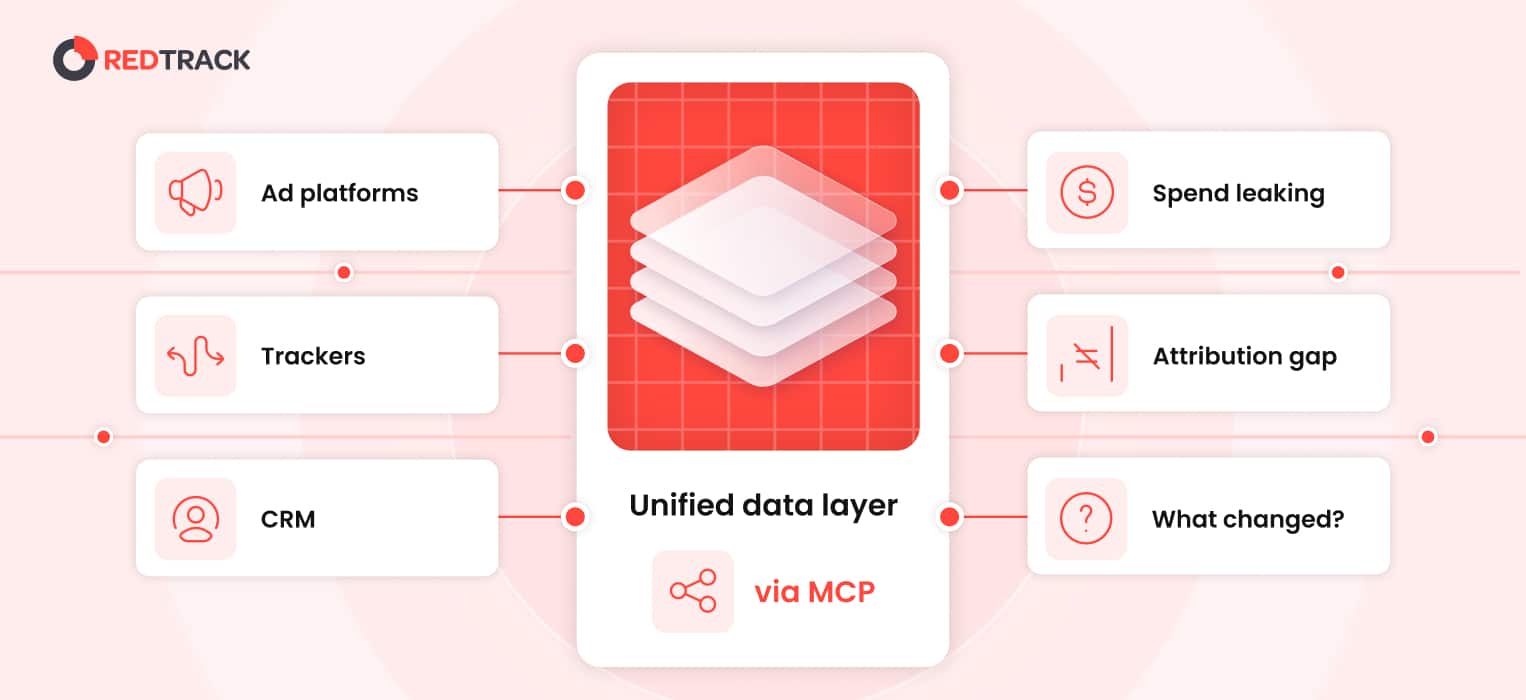
RedTrack is the working surface advertisers use to run their paid acquisition: one place across all platforms and channels, built on the advertiser’s own first-party data. We capture click and conversion events server-side, at the moment they happen, including the ones pixels lose. That becomes one consistent data layer.
Everything else (measurement, analysis, signal restoration, automation, AI) operates on that same data layer. That last part is the structural difference. In a fragmented stack, every tool holds a different version of the truth. With RedTrack you have a single source of truth, and every other tool reads the same records.
The industry is saturated with AI announcements. Why did RedTrack move toward AI now, and how is this not just another one?
Because we answered a prior question first: what does AI in this market actually lack? Not intelligence. The models are capable. What it lacks is trusted data and the APIs to act. Point an AI at a typical marketing stack, and it spends its capability reconciling contradictory views from different systems, then reasons confidently from a broken picture.
Unified Data Layer
AI on broken data automates the error.
Vlad, CEO of RedTrack
We spent years building the part that fixes that: the first-party data layer and the API integration infrastructure. Now we “just” add AI on top of it. So our position isn’t AI competitor; it’s AI enabler. We’re not trying to out-model anyone. We’re providing the thing every model needs and almost none of them have in this market: a complete, consistent data layer with normalized records of what actually happened, and a defined way to act on it.
So what does RedTrack’s MCP provide?
Three things, in increasing order of importance.
Access. It makes the account’s data and defined actions available to the AI tools and LLMs of your choice. A human can reach the data from whatever interface they prefer, and an AI agent works on real data instead of pasted CSVs and screenshots.
Answers. It answers operator questions against the full account data, right from the LLM: where spend is leaking, what changed and why, without exports or spreadsheet archaeology.
The first pass. AI does the first read of the data. Most time in media buying goes to reconnaissance: checking what changed and deciding what deserves attention. When that pass happens before a human opens a dashboard, the team’s time moves from reading to deciding. That’s how volume scales without team size scaling alongside it.
For someone hearing “MCP” for the first time: what is it, and why should they care?
It’s an open protocol that lets AI systems work with structured data and take defined actions, instead of the copy-paste relationship most people currently have with AI tools.
The operator shouldn’t care about the protocol itself, the same way they don’t care what programming language their tracking is written in. What they should care about is the consequence: the AI sees the actual account, and it can act within defined rails rather than just describing what someone else should do.
What’s the honest limitation? What should an operator not expect?
They should not expect the AI to replace judgment, and they should not expect good output on top of bad inputs. If an account’s tracking is fundamentally not set up, the AI has nothing truthful to read. Accurate tracking is the precondition.
And decisions stay with the operator. The AI agent reads, highlights, prepares, and acts within the guardrails it’s given. It does not get to decide what the business is trying to do. Well, it can, but that would pose a risk.
Where does the product go from here?
Today RedTrack is strongest at the data layer: capturing first-party data, restoring the signal, running and improving live campaigns. We always strive to keep the UI simple and usable while covering more of what media buyers need.
AI opens RedTrack up to jobs beyond tracking, analytics and automation, without the need to invest in new UI. Planning, ad and campaign creation, data modeling and forecasting all become possible through a chat interface, without building a new screen for each one.
Over time, an advertiser will run the entire paid acquisition workflow through one system, most likely sitting outside the UIs of the tools they use. We expect to power that system with data, integrations and AI agents for media buyers. We are built for a market where the work is done by humans and AI together. The MCP is the first visible step of that second half.
For an operator who left RedTrack a year or two ago, what would you tell them?
That the product they evaluated has a very different shape and function, and I mean that literally rather than promotionally. What they likely assessed was a tracker with accurate reporting. What exists now is data infrastructure, analytics and automation, with LLMs and AI agents working on top of those tools. This isn’t wishful thinking; it’s the concentrated experience of early adopters since we released our MCP in June 2026.
For them, the evaluation question has changed. It used to be: “Is this tracker worth the setup?” Now it’s: “Do I want my AI to work on inconsistent datasets across multiple tools, or to access a single system with consistent, normalized data to analyze and a vast array of pre-built APIs to act on the insights it generates?” I’d just ask them to re-run the evaluation against the second question.
Rapid Fire: Tracking Mistakes, Wasted Spend and Affiliates
What are paid media teams still getting wrong about tracking in 2026?
I run into two things most often. The first is treating tracking as a one-time setup instead of an ongoing process. Setup is just the foundation; it needs constant maintenance and monitoring. That’s actually why we built our Health Center: to catch the big, obvious breaks, like a Meta integration going down. But there are dozens of smaller issues underneath that a media buyer should also be watching for.
The second is treating tracking as an isolated task, disconnected from the rest of the workflow. Tracking exists to create data, and the value only shows up when you use that data: feeding it back to ad platforms through Conversions API, making optimization calls, or powering automation. If there’s one thing every successfully scaling media buying team has in common, it’s a solid data foundation underneath everything else.
What is one expensive mistake media buyers make when they rely only on platform dashboards?
Platform dashboards report platform truth, not business truth, and the more ad platforms you run, the wider that gap gets. The discrepancy itself isn’t the mistake; most buyers already know it exists. The mistake is what they do about it. Without near-real-time, unified data, they end up making budget decisions based on whichever dashboard happens to look best that day. And the cost of that mistake scales directly with ad spend.
Can AI actually find wasted spend before a human would?
Yes, and not for some glamorous reason. A human checks an account on a schedule; a system checks it continuously. AI can flag deviations earlier, even if it’s not always perfectly accurate, and surface them before a person would ever notice on their own.
What changes for affiliate marketers specifically, compared to ecommerce brands?
Affiliate marketers operate in a far more fragmented system than most ecommerce brands do. The buyer, the network, the offer, the traffic source and the landing page all live in separate places. An ecommerce brand has a natural center of gravity: the webstore, with a backend that captures 100% of sales, so there’s always at least one source of truth to reconcile everything against.
Affiliates don’t have that anchor. Which makes clean, unified data both harder to achieve and far more valuable.
Want to try RedTrack? Use my discount code “IAMATILLA50OFF” to save you 50% out of each plan!
We use cookies on our website to give you the most relevant experience by remembering your preferences and repeat visits. By clicking “Accept All”, you consent to the use of ALL the cookies. However, you may visit "Cookie Settings" to provide a controlled consent.
This website uses cookies to improve your experience while you navigate through the website. Out of these, the cookies that are categorized as necessary are stored on your browser as they are essential for the working of basic functionalities of the website. We also use third-party cookies that help us analyze and understand how you use this website. These cookies will be stored in your browser only with your consent. You also have the option to opt-out of these cookies. But opting out of some of these cookies may affect your browsing experience.
Necessary cookies are absolutely essential for the website to function properly. This category only includes cookies that ensures basic functionalities and security features of the website. These cookies do not store any personal information.
Any cookies that may not be particularly necessary for the website to function and is used specifically to collect user personal data via analytics, ads, other embedded contents are termed as non-necessary cookies. It is mandatory to procure user consent prior to running these cookies on your website.